

The Context7 Admin MCP server is a remote MCP server that lets an agent manage your Context7 account: teamspace members, libraries, rules and policies, usage, Docs7 sites and Ask sites.
For documentation lookup, use the Context7 MCP server (https://mcp.context7.com/mcp) instead.
Connect#
Server URL: https://admin.mcp.context7.com/mcp
Clients that add a remote server as a connector take this URL instead:
- Claude.ai and Claude Desktop — Customize → Connectors → + Add → Add custom connector. On a Team or Enterprise plan, an owner adds it in Organization settings first.
- ChatGPT — on the web, chatgpt.com/plugins → + → Add custom MCP server → Create as a plugin; in the desktop app, Settings → MCP servers → Add server (Streamable HTTP).
The connector asks you to sign in while you add it. In the ChatGPT desktop app, use Authenticate on the server.
Authentication#
OAuth#
Clients that support MCP OAuth ask you to sign in with your Context7 account on the first request, and sign in again when the token expires.
API key#
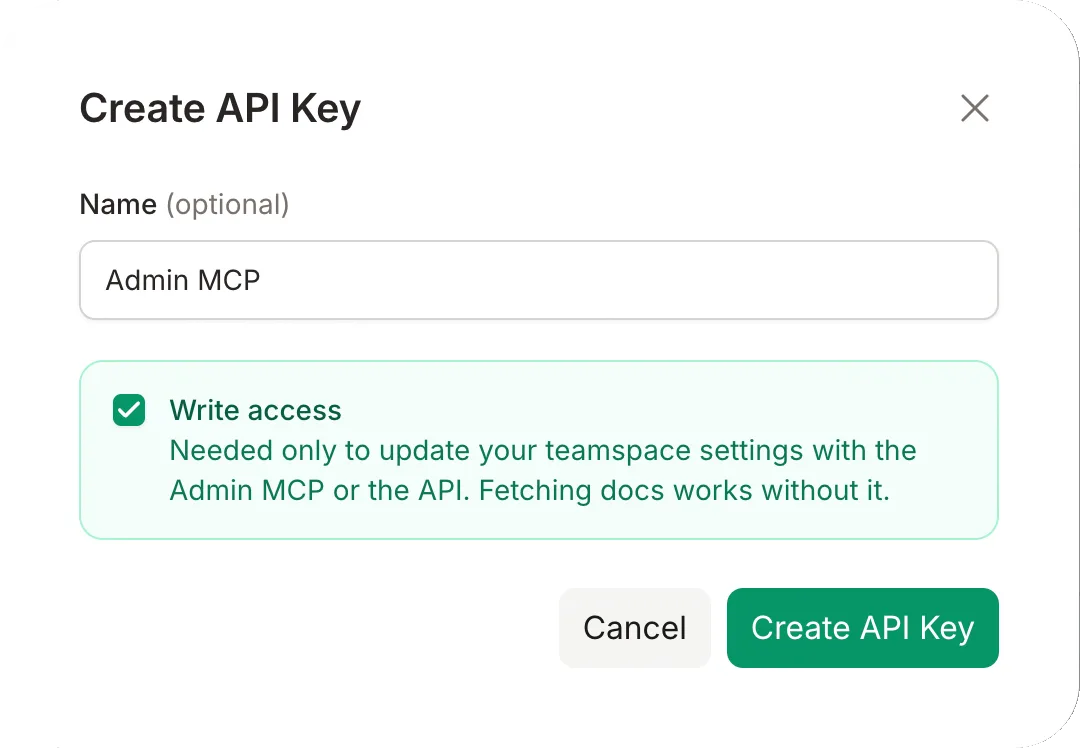
Create a Context7 API key in the dashboard and send it as a bearer token. Every key can use the read tools, except those that return personal data: members and invitations, library requests, Ask questions, Docs7 reader searches, conversations, feedback, feature requests and the GitHub account behind a build. To read those or make changes, tick Write access when you create the key; a key without it gets 403 write_access_required. A key reaches only its own teamspace. See Write access.
Teamspaces#
One OAuth connection reaches every teamspace you are a member of, with your role in each.
- Each tool takes
teamspace: an id or a name. Leave it out when you have one teamspace. With several, the error lists them, and you can pass a differentteamspaceon each call to work on more than one in a session. - Docs7 and Ask sites belong to a teamspace.
docs7_list_sitesandask_list_sitesgive their ids; every site tool takessite_id(Docs7) orsite_key(Ask). - An API key belongs to one teamspace. Use one key (and one server entry) per teamspace.
- To limit what an agent can do (read only, some tools only), use your client’s tool settings: Claude connectors and Claude Code permissions can turn each tool off or make it ask first.
Tools#
- Library ids take
/owner/repo,owner/repo, or acontext7.comlibrary URL. - Long jobs (library parse, Docs7 build, Ask crawl): call
get_library,docs7_get_deploymentorask_get_sitewithwait: true. The server waits up to about 25 seconds for a final state. - The Docs7 agents run on their schedules, which
docs7_update_sitesets. This server reads their runs and does not start them.
| Group | Tools |
|---|---|
| account | list_teamspaces, open_console, get_teamspace, manage_members |
| libraries | list_libraries, get_library, add_library, refresh_library, update_library_config, manage_library_versions, claim_library, remove_library, get_library_analytics, get_library_suggestions, get_library_benchmarks, manage_owned_library |
| rules | manage_rules, get_library_policies, update_library_policies, manage_library_requests |
| usage | get_teamspace_usage, set_spending_limit |
| docs7 | docs7_list_sites, docs7_get_site, docs7_create_site, docs7_update_site, docs7_check_domain, docs7_list_deployments, docs7_get_deployment, docs7_deploy, docs7_remove_preview, docs7_get_agent_runs, docs7_list_pull_requests, docs7_connect_repository, docs7_manage_example_check, docs7_manage_feature_requests, docs7_get_analytics, docs7_query_logs, docs7_get_conversation |
| ask | ask_list_sites, ask_get_site, ask_create_site, ask_verify_site, ask_delete_site, ask_get_analytics, ask_list_questions |
| feedback | submit_feedback_to_context7_team |
submit_feedback_to_context7_team sends the agent’s report on a missing, broken or confusing tool to the Context7 team, not to your teamspace. The agent calls it at most once per task; it takes task, kind (missing, broken, confusing or idea), impact (blocked, worked_around or friction), description and an optional tool_name, and takes no teamspace. With an API key, it needs a key with Write access.
list_libraries and docs7_list_sites return 50 items per page with total, page and pages. list_libraries also takes search (part of a library’s id, title or source URL) and order: "lowest" (lowest benchmark score first); docs7_list_sites takes search (part of a site’s name, repository, address or library id). A page past the last one is an error.
Adding and indexing a library#
add_library takes a source — github, gitlab, bitbucket, git (any other Git host), website, llmstxt or openapi — and a url. The url is the repository, documentation website, llms.txt or OpenAPI spec URL, depending on the source; for GitHub, GitLab and Bitbucket it is the repository URL. The parse takes minutes, so call get_library with the returned library id and wait: true until the state is complete or error.
Optional inputs:
private: trueadds a repository as a private source (owner or admin, paid plan). The GitHub, GitLab or Bitbucket account must be connected in the dashboard first.generate_docs: truegenerates docs from the source of a private repository.website_base_urllimits a website crawl to pages under that URL.
Confluence, Notion and file uploads are not in this server; add them in the dashboard. To change how a library the teamspace owns is parsed, call update_library_config with only the fields to change, then refresh_library to apply them. update_library_config takes branch, folders, exclude_folders, exclude_files, rules, base_url, web_url, exclude_urls, use_query_params and keep_version_specific_pages, among others. folders and exclude_folders take at most 50 entries, exclude_files at most 100, and each entry at most 255 characters. refresh_library starts a parse and is subject to the daily refresh limit.
Versions#
get_library returns the library’s indexed versions, and manage_library_versions adds or removes one. A version is a tag or branch name, or, for a website, the docs URL of that version; pass is_branch: true for a branch. After add, call get_library with wait: true. remove needs confirm set to the version name. Versions also come from previousVersions in the library’s context7.json, and when a refresh finds a new major release, Context7 keeps the previous major as a version. Context7 adds the versions of the most popular public libraries itself.
Console#
In clients that support MCP Apps (Claude, ChatGPT, VS Code, Cursor), open_console shows a summary card in the chat — a teamspace’s usage and spend, libraries and benchmark scores, Docs7 sites, or Ask sites — with an Open console action that expands it to the full console. view picks the card (usage, libraries, docs7 or ask; default usage) and teamspace takes an id or name. In other clients open_console returns the teamspace list as text.
The page holds no credential of its own: it reads through console_data, an app-only tool (_meta.ui.visibility: ["app"], hidden from the model) that runs one of the console’s read tools and answers in structuredContent. The client calls it for the page with your sign-in. All other tools except open_console are hidden from the page, and requests that need the model (“Fix the lowest”, “Find doc gaps”) are sent to the chat as your next message.
Management API#
The same operations are available over the REST API at /api/v2/teamspaces/{teamspaceId}, so a script can use them without an MCP client. It takes the same credentials as this server: an API key, which reaches only its own teamspace and can make changes or read personal data only with Write access, or an OAuth token issued for this server. See the API reference for the routes.
Safety and limits#
- Remove and delete actions (
remove_library,manage_membersremove,manage_library_versionsremove,manage_rulesdelete,manage_owned_libraryblockandtransfer,docs7_manage_feature_requestsdelete,docs7_remove_preview,ask_delete_site) are marked destructive, so your client asks you before it runs them. When the client supports form elicitation (MCP protocol 2026-07-28), the server also shows you a form where you type the exact target — the library id, email, version, rule id, request id, branch or hostname — and the agent cannot answer it for you. In other clients the agent passes the target asconfirm: ask it to wait for your yes instead of letting it fill the value in itself. - Deleting a whole Docs7 site cannot be undone, so it is not in this server. Do it in the dashboard.
- Results that hold third-party text (questions, searches, feedback, build logs, agent runs, library suggestions and benchmark questions) are fenced in
<untrusted-data-…>tags. docs7_get_deploymentwithinclude: ["origin"]needs Write access, becauseoriginnames the GitHub account behind the build. A read-only key still gets the build and the other parts, withoriginreplaced by anerrorobject.- Results above about 20,000 tokens are cut, with a note on how to narrow the request.
Billing, plans, API keys, SSO and teamspace create or delete are not in this server. Use the dashboard.